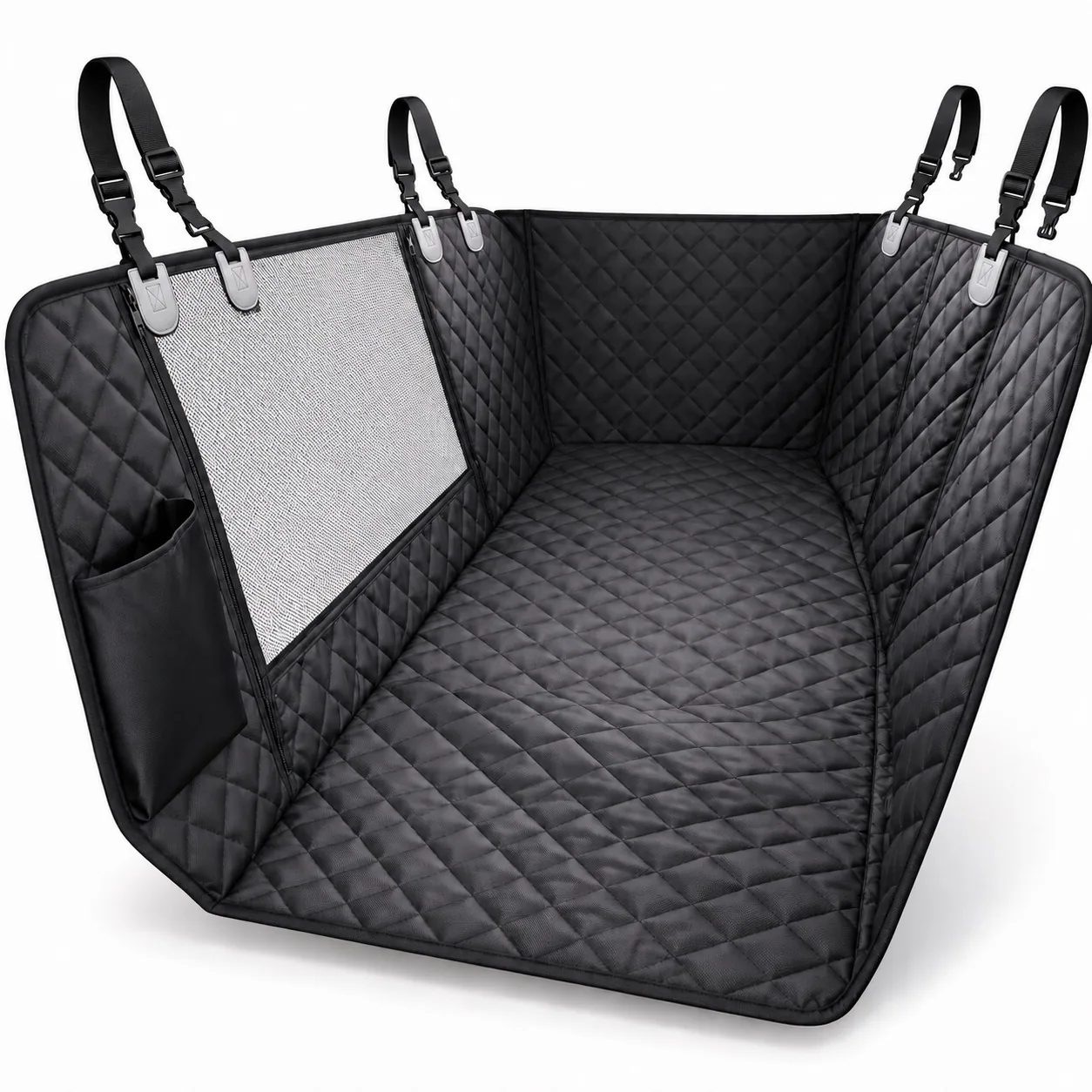
A good car seat for dogs suits your dog’s weight and size and can be secured so your dog doesn’t slide around the car in turns or when you brake. Small dogs usually ride best in a raised booster seat with a tether, while larger dogs are safer on the back seat or in the cargo area, each with a harness and seat belt tether.
In this guide we compare the options, explain the differences between a seat, a back seat cover and cargo area protection, and give you a checklist for your buying decision. You’ll find a larger selection in our Dog in the Car collection.
Why a secure car seat for dogs matters
An unsecured dog is a risk to themselves and to everyone in the car during hard braking. In a sudden stop, forces act on an animal that no one can hold back by hand. Then there’s the distraction: a dog sitting on your lap or wandering between the seats takes your attention and your freedom to move.
As a general rule, anything in your vehicle, including a pet, should be secured so it can’t shift or endanger anyone when you brake or swerve. How exactly you do that is up to you. What matters is that the restraint suits your pet, your car and your route. If you’re unsure about the details, ask your auto insurer or check the rules where you live.
Front seat or back seat: where does your dog ride best?
For most dogs, the back seat is the calmer and more practical spot. Your dog has more room, and you don’t have to worry about a front passenger airbag. In the front seat, a deployed airbag can be dangerous for an animal. If you do use the front seat, check your vehicle’s owner’s manual to see whether the airbag can be switched off, and move the seat back as far as possible.
Still, the front seat has advantages for small dogs: your dog can make eye contact with you, and many dogs ride more calmly that way. A model like the linen-look dog car seat offers a box-shaped seat tub with side walls and a full-length backrest cover that protects the whole seat. The side walls can be zipped flat or raised.
Size and weight: small and large dogs
The most important question when buying is how heavy and how big your dog is. A booster seat is designed for small dogs. The heavier the animal, the greater the load on the straps and mounting, and the more sense it makes to choose a back seat or cargo area setup.
Small dogs and cats
- A raised booster seat lifts your dog to window height, which makes the ride easier for many dogs.
- A safety hook or safety lead inside the seat, clipped to the harness, keeps your dog from jumping out.
- A removable, washable cover makes cleaning easier.
Examples: the velvet booster seat with washable cushion has a safety hook and two straps for a firm hold. The center console car seat sits between the driver and the passenger, has a safety lead for the harness and, with the shoulder strap, doubles as a carrier bag.
Medium and large dogs
A booster seat is usually too small for these dogs. A back seat cover with a seat belt tether or a protected cargo area are the usual solutions. Some dogs also ride in a sturdy crate in the cargo area; you’ll find models in our dog crates. Important: the crate has to be fixed in place in the car so it can’t slide.
Securing your dog with a harness and tether
A car seat alone doesn’t secure your dog. What counts is the connection between your dog and the vehicle. A well-fitting chest harness with a seat belt tether attached to it is a proven choice. A collar isn’t suitable for this, because a sudden jolt puts pressure on the neck.
- The harness must be snug enough that your dog can’t slip out, but not so tight that it cuts in.
- The tether should be short enough that your dog can’t fall off the seat, but still long enough to sit or lie down comfortably.
- Check buckles and stitching regularly for wear.
You’ll find suitable models under dog harnesses. Some of our back seat and seat products already come with a dog safety belt, such as the split quilted back seat cover. We don’t claim any test certifications: a belt and harness reduce sliding, but they don’t replace careful driving on your part.
Cargo area protection or back seat protection?
Both options mainly protect your car. They don’t automatically secure your dog; for that you still need a harness and tether or a fixed crate.
Back seat protection
A protective cover or hammock covers the seat and the backrest and catches dirt, moisture and hair. Depending on the model, the seat belt buckles stay accessible or side flaps protect the door panels. You’ll find an overview in our dog blankets. The black protective cover covers the seat and backrest completely and stays in place with elastic straps. For dogs that slip between the seat and the footwell, there are back seat extenders with a firm resting surface, such as the dog bed for the back seat, which is split so passengers can still sit in the back.
Cargo area protection
In a wagon, SUV or van, your dog can travel in the cargo area. A cargo liner protects the floor, the side panels and, depending on the model, the loading edge. The cargo liner with side protection also has a fold-down bumper flap. Important: if needed, separate the cargo area from the passenger compartment with a cargo barrier, or secure your dog another way. Your vehicle manufacturer is the best source for details on this.
Decision guide at a glance
| Situation | Suitable solution | What to look out for |
|---|---|---|
| Small dog, driver alone | Booster seat on the front seat or center console | Check the airbag, clip your dog to the harness |
| Small dog, back seat | Hanging basket for one seat | Pull straps tight, basket must not wobble |
| Medium-sized dog | Back seat protection with seat belt tether | Chest harness, short tether |
| Large dog, wagon or SUV | Cargo area protection, plus a crate or barrier if needed | Secure against sliding, ventilation |
| Dog slips into the footwell | Back seat extender with a firm resting surface | Fit for your back seat |
Checklist before you buy
- Have you noted your dog’s weight and body size?
- Should your dog ride in front, in back or in the cargo area?
- Do you have a chest harness, and does it fit well?
- Is the seat belt tether included, or do you need to get one separately?
- Do the dimensions fit your back seat or your cargo area?
- How often does the cover need washing, and is it removable?
- Can you still use the seat belt buckles and armrests when passengers are along?
- Will your dog be comfortable on long drives too?
Getting used to it and everyday use
Let your dog get to know the new spot in the parked car first, with treats and calm praise. Short drives come next. On longer trips, plan regular breaks for bathroom stops and water, and never leave your dog in a parked car, especially in the sun. If your dog gets car sick or is very anxious in the car, talk to your vet.
Frequently asked questions
Can my dog sit in the front seat?
Generally yes, as long as they’re secured. First check whether the front passenger airbag can be switched off, and set the seat in a position where your dog has a firm footing. For many dogs, the back seat is the easier spot.
Is a car seat without a tether enough?
Usually not. A booster seat gives support and comfort, but it only secures your dog together with a tether or safety lead attached to the harness.
Is cargo area protection enough on its own?
It protects your car from dirt and scratches. For your dog’s safety you also need something that stops them from sliding, for example a harness with a tether, a fixed crate or a suitable cargo barrier.
Which seat suits a very small dog?
A raised booster seat with a safety hook or safety lead is usually a good fit. A well-fitting harness matters, as does a spot where your dog won’t get in your way while you drive.
What’s the best way to clean the cover?
For water-repellent, quilted covers, shaking out and wiping down is often enough. Removable cushion covers can go in the washing machine, depending on the care instructions.
If you’re not sure which model fits your dog and your car, just write to us. We’ll tell you honestly what fits and what doesn’t.