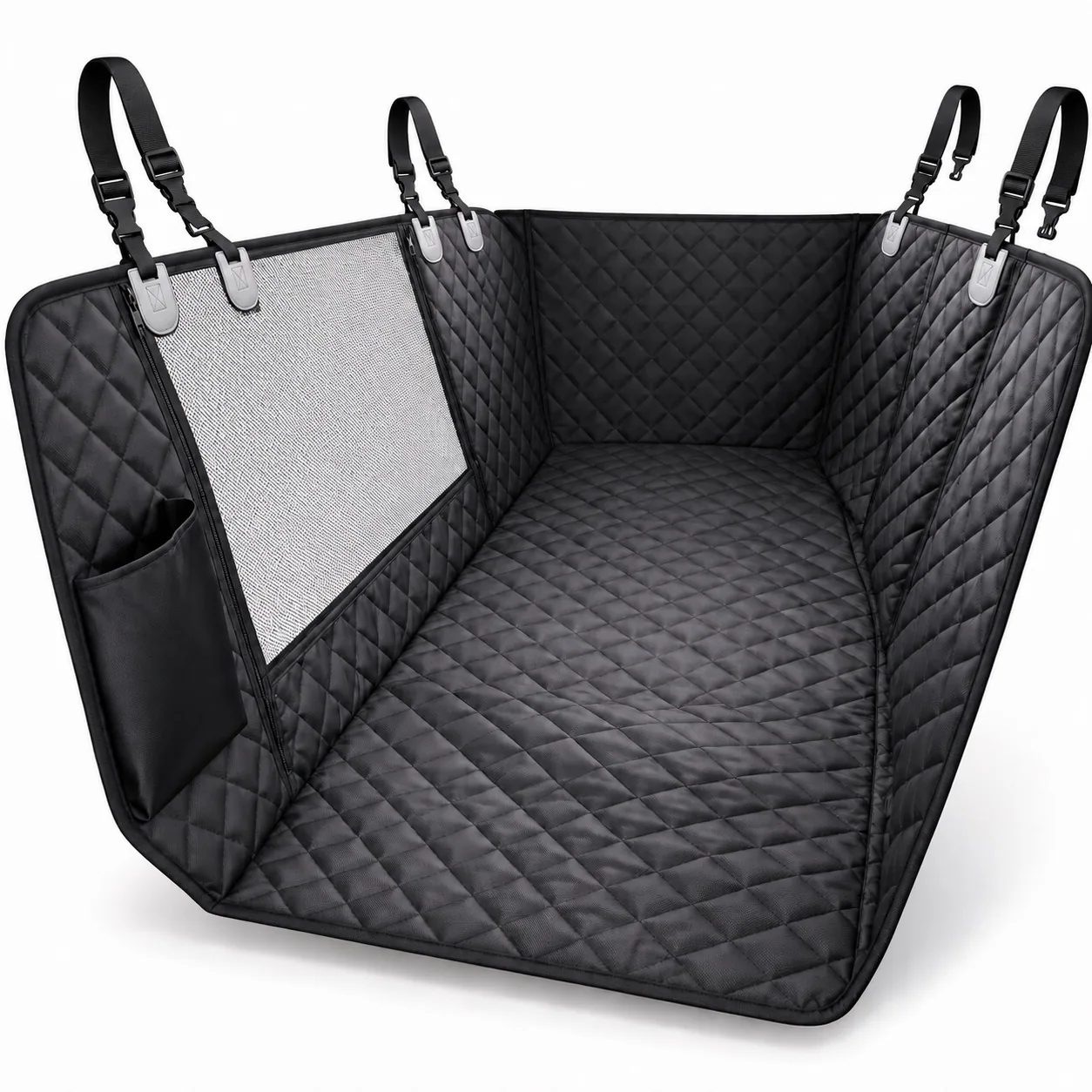
A good dog car seat suits your dog’s weight and size and can be secured so your dog doesn’t slide around the car on bends and when braking. Small dogs usually travel best in a raised seat box with a belt, while larger dogs are safer on the back seat or in the boot, each with a harness and a seat belt attachment.
In this guide we compare the options, explain the differences between a seat, back seat protection and boot protection, and give you a checklist for choosing. You’ll find a bigger selection in our Dog in the car collection.
Why securing your dog in the car matters
An unsecured dog is a risk to itself and to everyone in the car when you brake hard. In an emergency stop, the forces acting on an animal are more than you could ever hold back by hand. Then there’s the distraction: a dog sitting on your lap or wandering between the seats takes your attention and your freedom of movement.
In the UK, as in Germany, the general principle is that loads, and so animals in the vehicle, must be secured so they don’t shift or put people at risk when braking or swerving. The rules leave the exact method open. What matters is that your restraint suits your dog, your car and the length of the journey. If you’re unsure about the details, ask your car insurer or a driving instructor.
Front seat or back seat: where is best for your dog?
For most dogs, the back seat is the calmer and more practical spot. Your dog has more room, and you don’t need to worry about a front passenger airbag. On the front seat, a deployed airbag can be dangerous for an animal. If you do use the front seat, check in your car’s handbook whether the airbag can be switched off, and move the seat back as far as possible.
The front seat does have advantages for small dogs: your dog can see you, and many dogs travel more calmly as a result. A model such as the linen-look dog car seat offers a box-shaped seat tray with side walls and a full-length backrest cover that protects the whole seat. The side walls can be zipped flat or stood up.
Size and weight: small and large dogs
The most important question when buying is how heavy and how big your dog is. A seat box is made for small dogs. The heavier the animal, the greater the load on the belts and fixings, and the more sensible a back seat or boot solution becomes.
Small dogs and cats
- A raised seat box brings your dog up to window height, which makes the journey easier for many dogs.
- A safety hook or safety lead inside the box, attached to the harness, stops your dog from jumping out.
- A removable, washable cover makes cleaning easier.
Examples: the velvet seat box with washable cushion has a safety hook and two straps for a firm hold. The centre console dog car seat sits between driver and passenger, has a safety lead for the harness and can also be used as a carrier with the shoulder strap.
Medium and large dogs
A seat box is usually too small for these dogs. A back seat cover with a seat belt attachment or a protected boot are the usual solutions. Some dogs also travel in a sturdy crate in the boot; you’ll find models in our dog crates. Important: the crate must be fixed in the car so it can’t slide.
Securing your dog with a harness and belt
A car seat on its own doesn’t secure your dog. What counts is the connection between your dog and the vehicle. A well-fitting chest harness with a seat belt attachment is the tried and tested approach. A collar isn’t suitable for this, as a sudden jolt puts pressure on the neck.
- The harness must be snug enough that your dog can’t slip out, but not cut in.
- The belt should be short enough that your dog can’t fall off the seat, yet long enough to sit or lie comfortably.
- Check buckles and stitching regularly for wear.
You’ll find suitable models under dog harnesses. Some of our back seat and seat products already come with a safety belt for dogs, such as the split quilted back seat cover. We don’t claim any test certifications: a belt and harness reduce sliding, but they don’t replace careful driving.
Boot protection or back seat protection?
Both options mainly protect your car. They don’t automatically secure your dog; for that you still need a harness and belt or a fixed crate.
Back seat protection
A protective cover or hammock covers the seat and backrest and catches dirt, damp and hair. Depending on the model, seat belt buckles stay accessible, or side flaps protect the door panels. You’ll find an overview in our dog blankets. The black protective cover covers the seat and backrest completely and is held in place with elastic. For dogs that slip into the footwell, there are seat extenders with a firm lying surface, such as the back seat dog bed for the car, which is split so passengers can still sit in the back.
Boot protection
In an estate, SUV or van, your dog can travel in the boot. A boot liner protects the floor, the side trim and, depending on the model, the loading lip. The boot protector with side protection also has a fold-down bumper flap. Important: where needed, separate the boot from the passenger area with a dog guard, or secure your dog in another way. It’s best to ask your vehicle manufacturer for information on this.
Decision guide at a glance
| Situation | Suitable solution | What to look out for |
|---|---|---|
| Small dog, driver travelling alone | Seat box on the front seat or centre console | Check the airbag, clip your dog to the harness |
| Small dog, back seat | Hanging basket for one seat | Pull the straps tight, basket must not wobble |
| Medium-sized dog | Back seat protection with seat belt attachment | Chest harness, short belt |
| Large dog, estate or SUV | Boot protection, plus crate or guard if needed | Secure against sliding, ventilation |
| Dog slips into the footwell | Seat extender with a firm lying surface | Fit for your back seat |
Checklist before you buy
- Have you noted your dog’s weight and height?
- Will your dog travel in the front, the back or the boot?
- Do you already have a chest harness, and does it fit well?
- Is the seat belt attachment included, or do you need to buy it separately?
- Do the dimensions suit your back seat or your boot?
- How often will the cover need washing, and is it removable?
- Can you still use the seat belt buckles and armrests when passengers are on board?
- Will your dog be comfortable on long journeys too?
Getting used to it and everyday use
Let your dog get to know the new spot in a parked car first, with treats and calm praise. Short journeys then follow. On longer trips, plan regular breaks for toilet stops and a drink, and never leave your dog in a parked car, especially in the sun. If your dog suffers from travel sickness or is very anxious in the car, ask your vet if you’re in any doubt.
Frequently asked questions
Can my dog sit on the front passenger seat?
Generally yes, as long as it is secured. Check beforehand whether the passenger airbag can be switched off, and put the seat in a position where your dog has support. For many dogs, the back seat is the simpler place.
Is a dog car seat without a belt enough?
As a rule, no. A seat box gives support and comfort, but only secures your dog together with a belt or safety lead attached to the harness.
Is boot protection enough on its own?
It protects your car from dirt and scratches. For your dog’s safety you also need something that stops it sliding, for example a harness with a belt, a fixed crate or a suitable dog guard.
Which seat is right for a very small dog?
A raised seat box with a safety hook or safety lead is usually suitable. A well-fitting harness matters, as does a spot where your dog won’t get in your way while you drive.
What’s the best way to clean the cover?
With water-repellent, quilted covers, shaking out and wiping down is often enough. Removable cushion covers can go in the washing machine, depending on the care label.
If you’re not sure which model suits your dog and your car, just get in touch. We’ll tell you honestly what fits and what doesn’t.