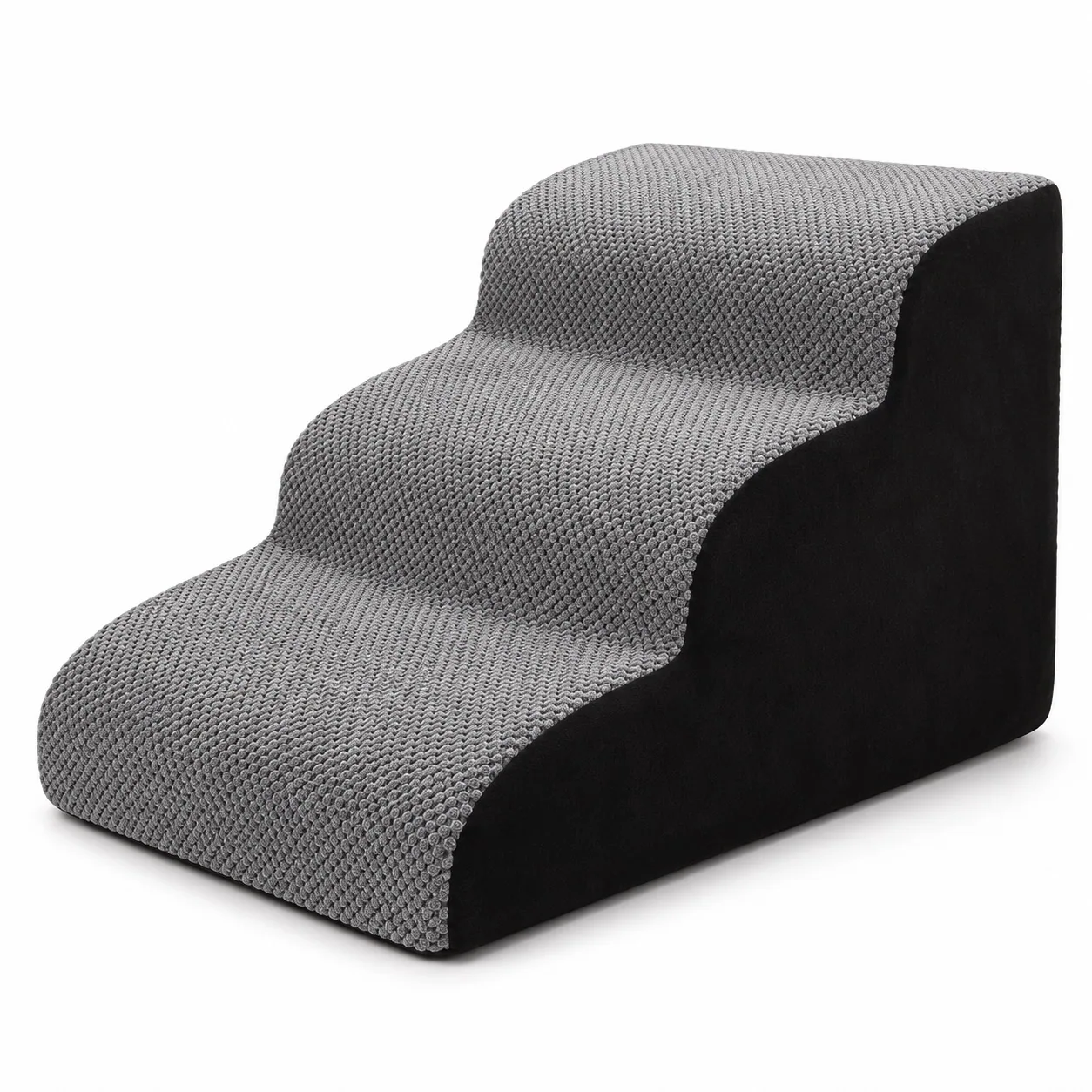
Many dogs naturally belong on the sofa or at the foot of the bed. For small dogs, puppies, short-legged dogs and older animals, though, each of these routes means a jump, and on the way down even a jump with a hard landing. A dog stairs or a ramp can make these routes more comfortable. But which solution suits your dog, how high does it need to be, and how does your dog get used to it? This guide gives you practical answers.
Why dog stairs can make sense
A jump onto a sofa looks harmless to us. For a small dog, though, the seat is very high relative to its own body size, and the jumping often happens several times a day. When jumping down, the front legs in particular absorb the weight. Stairs or a ramp divide the route into small, controlled steps and can thus ease the load on joints and back in everyday life.
One honest note matters to us here: dog stairs are an everyday aid, not a remedy. If your dog is limping, hesitates when getting up, shows pain or suddenly no longer wants to jump, please have the cause checked by a vet first.
Which dogs are stairs or a ramp suitable for?
- Small dogs and puppies: For them the sofa and bed are especially high in proportion.
- Dogs with a long back and short legs: Dachshunds, corgis or bassets aren’t ideal sweaters; a gentle way up is more comfortable for them.
- Older dogs: With the years, some sofas become too high. An aid preserves the accustomed closeness to the family.
- Compact breeds: French bulldogs or pugs manage well with shallow, wide steps.
- Cats: Older cats too like to use soft steps as a way onto the bed.
You’ll find many more aids for older four-legged friends, from stairs to a soft place to lie, in our senior dog supplies collection.
Stairs or ramp: the direct comparison
| Dog stairs | Dog ramp | |
|---|---|---|
| Movement | Individual steps, similar to a normal staircase | Continuous slope without steps |
| Space needed | Compact, stands right in front of the sofa or bed | Needs more length; the shallower, the longer |
| Especially suitable for | Small dogs, puppies, compact breeds | Long-backed dogs, dogs that don’t like steps |
| In everyday use | Usually stays in place, cover often washable | Often foldable and can be stowed under the bed or sofa |
In short: stairs save space, and a ramp is the gentler movement. If your dog hesitates at steps or has a long back, a ramp is often the easier choice.
Measuring the right height
Before you order, pick up a tape measure:
- Measure the height of the seat or the top of the mattress from the floor, at the spot where your dog is meant to go up.
- Compare this height with the height of the top step. A small last step is no problem for most dogs, but a big jump shouldn’t be needed any more.
- Check the space in front of the furniture: how much depth is available for stairs or a ramp?
- Take the floor covering into account. On smooth laminate or tiles, a non-slip underside is especially important.
An example from our range: the dog stairs for the bed in graphite come with 2 steps (approx. 40 × 40 × 30 cm) and with 3 steps (approx. 55 × 40 × 35 cm). With a bed about 45 to 50 cm high, your dog therefore still needs a small last step at the top. For very high box-spring beds these stairs are too low, and a ramp or a taller model makes more sense. We’d rather tell you that beforehand than after delivery.
How to recognize good dog stairs
A firm stance
Stairs that slide away when stepped on unsettle any dog. Look for a non-slip underside and place the top step as close as possible to the bed or sofa frame.
Grippy treads
Textured fabrics or a ribbed carpet surface give paws and claws grip. Smooth surfaces are unfavourable, especially for older dogs.
Shape-retaining material
Foam stairs made of firm foam keep their shape and are pleasantly soft. If they’re delivered compressed, give them up to 48 hours after unpacking to reach their full shape.
Easy-care cover
A removable cover with a zip can be washed gently. With dog hair and paw marks in everyday life, that is worth its weight in gold.
The ramp for sofa and bed
Our foldable wooden dog ramp has a frame in light solid wood and a walking surface in ribbed, non-slip carpet. Using a support with notches, you set the slope to suit the sofa or bed; after use you fold the ramp flat and slide it under the bed. It is designed for small and medium-sized dogs and for the home, not for the car. We don’t have a binding maximum load; for heavy dogs, please ask us before buying. You can see all models in our dog stairs & ramps collection.
How your dog gets used to stairs or a ramp
Most dogs don’t understand straight away what the new piece of furniture is for. With patience and treats, though, it almost always works.
- Initially place the stairs or ramp flat or freestanding on the floor and let your dog sniff at it.
- Put a treat on the bottom step or at the start of the ramp and praise every step.
- Build up slowly: treat one step higher, then on the next, finally on the sofa.
- Practise the way down too. It’s especially when coming down that the help is most valuable.
- Stay with him for the first few days and practise several times briefly rather than once for a long time.
A little trick: if your dog keeps jumping, place the stairs so that the direct jump onto the sofa becomes harder at that spot, for example in a corner.
Additions for more comfort
Anyone who makes the sofa easier for their dog often also thinks about a comfortable place of his own to lie. A dog sofa with a low entry and padded rim offers a spot at floor level, with no stairs at all. You’ll find more places to lie in our dog beds.
Conclusion
Whether stairs or a ramp, what matters is the right height, a firm stance and grippy treads. Measure before buying, choose the solution according to your dog’s build and preferences and allow a few days for practice. If you’re unsure which model suits your sofa or bed, write to us with the height and we’ll gladly help.