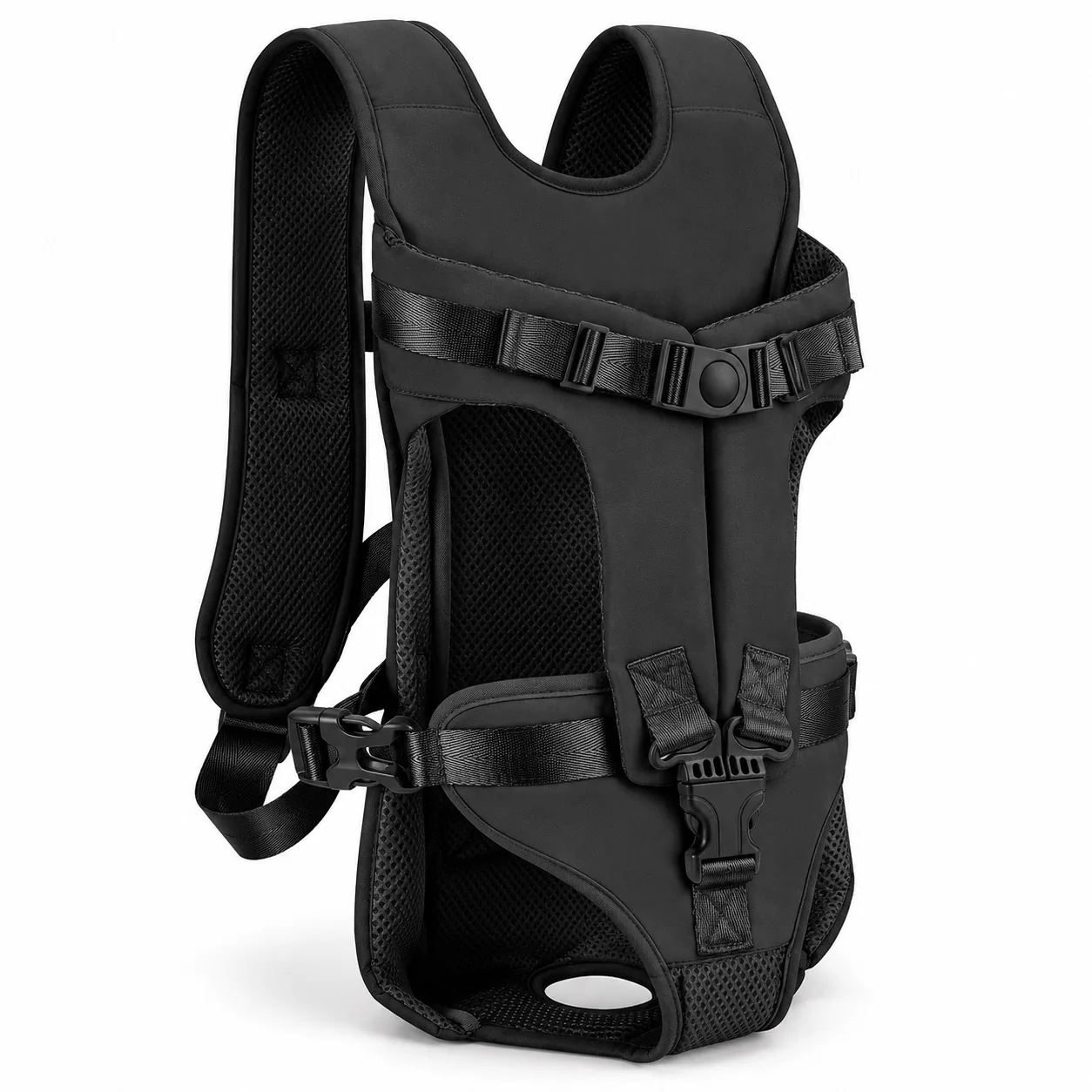
A backpack for dogs works well for small dogs you want to carry from time to time, such as on day trips, in crowds or on hikes when your dog gets tired. What matters most is the model’s maximum weight, good ventilation and padded straps that go easy on your back.
A dog backpack is no substitute for a walk on four paws. It helps in situations where walking is difficult or impractical. In this guide you’ll learn which dogs a backpack suits, how front and back carriers differ, and how to gently get your dog used to being carried.
Who Is a Backpack for Dogs Suitable For?
A backpack for dogs is designed first and foremost for small dogs. The models in our range have different maximum weights depending on their construction: one version is rated for up to about 14.5 kg, others for up to 8 kg or 7 kg. Always check the figure listed for the specific model, and don’t cut it close to the limit.
A backpack makes sense in cases like these:
- Your small dog tires on longer outings and needs a break now and then.
- You’re out on buses, trains, pedestrian zones or at events where it gets crowded.
- Your dog is a senior or recovering, and you’d like to give them a rest on parts of the route. If there are health concerns, ask your vet when in doubt.
- The route has stretches of hot asphalt, broken glass or very steep terrain.
A backpack is less suitable for dogs that clearly refuse to be carried, panic badly or are too heavy for the model. In that case, a well-fitting dog harness with plenty of breaks is often the better choice.
Front Carrier or Back Carrier: Which Suits You?
When you carry your dog on your front, you can see them and notice right away if they get restless. On your back, the weight is often distributed more comfortably, but you can’t keep an eye on your dog all the time. Some models can be worn on the front or the back, which adapts well to the terrain and the situation.
The following table can help you decide:
| Situation | Best way to carry | What to look for |
|---|---|---|
| Short distances, city, public transport | On the front, or a backpack with mesh windows | Your dog in view, easy access without lifting them in from the top, good ventilation |
| Longer hike | On your back, or switching between front and back | Padded shoulder straps, hip belt, weight distribution |
| Anxious dog | On the front, with the head free | Head opening, safety clip inside, calm introduction |
| Longer breaks on the go | Model with an expansion or a lying surface | Room to stretch out, sturdy frame, mesh as protection |
| Dog close to the maximum weight | Model with a larger weight reserve | Don’t push the stated limit, mind the wearer’s back |
Viewing Windows and Head Opening
Many dogs stay calmer when they can see what’s going on around them. Viewing windows or a mesh opening take away the cave-like feel of a backpack. There are two common designs:
- Head out: Your dog looks out of the top of the backpack. A drawstring limits the opening, and a safety clip inside attaches to the collar or harness so your dog can’t jump out.
- Closed with viewing windows: Your dog sits or lies inside and looks out through mesh or clear windows. This is calmer if your dog shouldn’t be watching everything all the time.
Only clip onto the harness or collar if the model is designed for it, and make sure the tether isn’t too short and doesn’t choke. A well-fitting harness is usually more comfortable here than a collar alone.
Ventilation and Temperature
A backpack is a tight space. Dogs release heat mainly by panting, so air circulation matters. Mesh fabric and mesh openings help. Still, keep the following in mind:
- In hot weather, let your dog walk instead, or plan your outing for a cooler time of day.
- Take regular breaks, lift your dog out and offer water.
- Watch for panting, restlessness or unusual tiredness. At the first signs of overheating, cool your dog down right away and ask your vet if in doubt.
- Never leave the backpack in a parked car.
A model with a reversible cushion can be handy: one side feels cool, the other cozy. That way you can adapt the lying surface to the season.
Weight and the Wearer’s Back
A 7 or 8 kg dog feels noticeably heavier after an hour than at the start. So think about your own back too:
- Choose backpacks with wide, padded shoulder straps. An extra chest strap and hip belt spread the weight across several points.
- Adjust the straps so the backpack sits snugly against your body and doesn’t swing.
- Don’t carry your dog the whole way, only on parts of the route.
- If you have back problems, talk to your doctor beforehand about how much load makes sense for you.
On top of your dog’s weight comes the weight of the backpack itself, plus any water and gear. It adds up faster than you’d think.
Getting Used to It: How to Start
Hardly any dog loves the backpack the very first time. Take it in small steps:
- Getting acquainted: Set the backpack out open at home. Put a blanket and treats inside so it becomes a positive place.
- Climbing in: Let your dog get in on their own and praise them. Don’t force it.
- Short carry: Lift the backpack with your dog inside for a few seconds, set it down again and reward them.
- First steps: At first, just walk around the house or the yard.
- Practicing outside: Start with short, quiet stretches before heading out on a day trip.
If your dog gets stressed and stays that way, stop and try again later, more slowly. Not every dog likes being carried.
Alternative: Carrier Bag Instead of a Dog Backpack
A carrier bag is a good option if you only carry your dog briefly or rarely. It hangs at your side or is held in your hand, which can be handy for short trips to the vet, a café or the train. For longer distances, though, it strains one side of your body more than a backpack, which spreads the weight across both shoulders. You’ll find an overview in our dog carrier bags collection.
As a rule of thumb: for short trips the bag is often enough, while for hikes and longer days the backpack is more comfortable.
Day Trips and Hiking with a Dog Backpack
Plan your outings so your dog walks as much as possible on their own. The backpack is your reserve for breaks, rough terrain or tired paws. These items are useful on the go:
- Water and a bowl, for your dog too.
- Poop bags and treats, ideally within reach in side pockets.
- A leash, so your dog doesn’t run off when you set them down. You’ll find suitable options under dog leashes.
- Reflective elements for dusk.
You’ll find more travel gear in the On the Go collection.
Our Models at a Glance
- Dog backpack to wear on the front or back: padded, in four sizes from S to XL, up to about 14.5 kg. Shoulder straps and hip belt, mesh fabric and tail opening, legs stay free. Great for hiking.
- Backpack for small dogs and cats: airy mesh fabric, head out, safety clip inside, reflective strips for dusk.
- Expandable dog backpack up to 8 kg: side mesh extension for more room during breaks, metal frame, reversible cushion, chest strap, hip belt and luggage strap.
Checklist Before You Buy
- Weigh your dog and compare the weight with the model’s maximum, leaving some margin.
- Check that your dog can sit or lie comfortably without being squeezed.
- Look for ventilation through mesh or openings.
- Choose padded shoulder straps plus a chest strap and hip belt for your back.
- Make sure there is a safety feature, such as a clip inside for a harness or collar.
- Decide whether you prefer viewing windows, a head opening or a side entrance.
- Allow time for getting your dog used to it.
- Think about where you’ll use it: city, hiking or travel.
Frequently Asked Questions
What weight is a backpack for dogs suitable for?
That depends on the model. Our range includes backpacks up to about 14.5 kg, as well as models up to 8 kg and up to 7 kg. Go by the figure listed with the product and leave some margin.
Is being carried in a backpack uncomfortable for dogs?
It varies from dog to dog. With a slow introduction, the right size and breaks, many dogs accept the backpack well. If your dog shows lasting stress, skip it. If you’re unsure, ask your vet.
Can I carry a cat in a dog backpack?
Some models are explicitly described for dogs and cats. Look for a safety feature, ventilation and a calm introduction. For trips to the vet, a cat carrier is often the sturdier solution.
How long can my dog stay in the backpack?
There’s no one-size-fits-all time. Plan regular breaks, offer water and keep an eye on your dog. The backpack should be an extra, not a permanent state of affairs.
Do I also need a harness?
Many backpacks have a safety clip that you attach to the harness or collar. A well-fitting harness is usually the more comfortable choice for that, and you’ll need it for walking anyway.
Not sure which backpack for dogs suits yours? Feel free to write to us and tell us which model you have your eye on. We’ll tell you honestly whether it fits, and we’ll advise against it if another model would suit better.