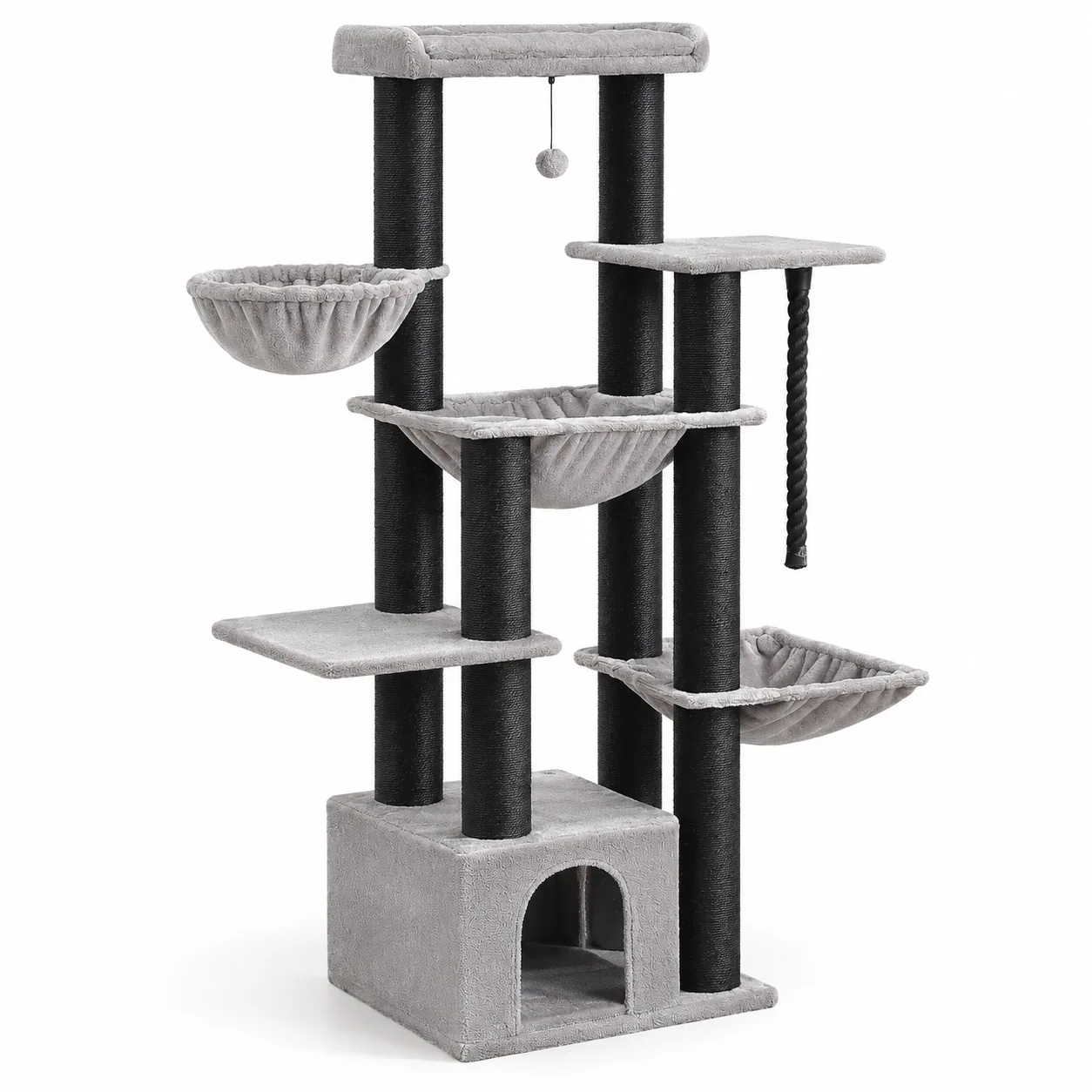
For an indoor cat, a cat tree is far more than a piece of furniture. It’s scratching spot, lookout tower, bedroom and retreat in one. If you’re looking for a cat tree for large cats or simply the right tree for your own home, you face many questions: how tall should it be? How can you tell it’s stable? And what do you do if there’s hardly any floor space? This guide helps you make the decision calmly and with a clear view.
What really matters with a cat tree
Cats don’t scratch to destroy furniture. They look after their claws, stretch the whole body and leave scent marks. At the same time they love raised spots from which they can survey the room. A good cat tree meets both needs: it offers surfaces for scratching at full body length and resting places at different heights. Three points are decisive, and you should check them before buying: the height in relation to your room, the stability and the size of the lying surfaces in relation to your cat.
The right height: how tall should a cat tree be?
There is no universally ideal height. Young, active cats like to climb right up to the ceiling, while older animals prefer low, easily reached levels. Before buying, measure the room height at the planned spot, especially with sloping ceilings, and leave a little headroom so that your cat can sit comfortably on the top platform.
| Situation | Sensible choice |
|---|---|
| Kitten or a calm single cat | Compact tree of around 100 cm with a low first step |
| Older cat | Low levels, resting place with a rim, possibly a ramp |
| Two to three active cats | Medium to large height with several levels and caves |
| Large breeds such as Maine Coons | Wide platforms, thick posts, wide base |
| Little floor space | Floor-to-ceiling tree with tension pole or a climbing wall |
In our cat trees collection you’ll find models from a compact 98 cm to well over two metres, so you can choose the height to suit room and cat.
Stability: posts, base and anti-tip device
Nothing unsettles a cat as much as a tree that sways when she jumps off. If the cat tree wobbles, she often avoids it for good. So look out for these features.
Thick posts
Thin posts spring back with a powerful jump. Thicker posts wrapped in sisal offer more grip when climbing and a larger surface for scratching. Heavy tomcats in particular notice the difference straight away.
A wide base
The taller the tree, the more important a wide, heavy base plate is. A base with an integrated cave lowers the centre of gravity further. In the product details, compare the information on base area and maximum footprint, because platforms often extend beyond the base.
Wall fixing and anti-tip device
For tall trees and several cats, we generally recommend using the wall fixing if it’s supplied. Our large 208 cm cat tree, for example, has a reinforced base with three metal brackets and an anti-tip kit for fixing to the wall. With every cat tree, also tighten all the screws again a few days after assembly, because wood and carpet settle a little at first.
Cat tree for large cats: what Maine Coons and co. need
Many standard cat trees are built for medium-sized cats. A fully grown Maine Coon, a Norwegian Forest cat or a powerful tomcat often simply doesn’t fit into the small lounging hollows and caves. So check the dimensions of the lying surfaces and compare them with your cat when she sleeps stretched out.
- Lying surfaces: Wide platforms and deep hammocks in which the cat can stretch out fully.
- Cave entrances: An entrance that is too narrow simply won’t be used.
- Gaps between levels: Large cats jump powerfully; the levels should be staggered so that the cat can land safely.
- Posts and base: Thick posts and a wide base are no luxury with heavy cats but a prerequisite.
One example is our 170 cm cat tree for large cats: thick sisal posts, a base of approx. 59 × 45 cm with an integrated cave, a 55 × 45 cm hammock and a top platform of 55 × 31 cm with a rim. According to the manufacturer, it’s designed for up to six cats. We’ve put together more models with generous dimensions in the cat trees for large cats collection.
Cat tree with tension pole: the solution for small flats
A cat tree with a tension pole uses the height of the room instead of its floor area. The post runs from floor to ceiling and is fixed there with an adjustable tension rod. That creates a climbing route over several levels on a small footprint.
Our cactus-design cat tree fits room heights from 229 to 275 cm and has a post 9 cm in diameter, five levels and a lying basket right at the top. The tension pole is only pressed in, not screwed. Turn it tight, but not by force; with delicate ceilings, a piece of felt in between can make sense. We also recommend the wall fixing supplied.
An honest note: floor-to-ceiling trees usually have narrower platforms. For medium-sized cats that’s ideal, but a fully grown Maine Coon finds more room on a large-surface cat tree.
Alternatives and additions
Not every home has room for a big tree. A cat climbing wall turns a free wall into a climbing trail without using up floor space. Many cats also like to scratch horizontally: a scratching board or cardboard scratcher in front of the sofa protects upholstery where the cat likes to scratch anyway.
Features: caves, hammocks and lounging hollows
Think about how your cat sleeps. Some like to burrow into a closed cave, others prefer to lie in the open in a hammock or on a platform with a rim. In multi-cat households it’s worth providing several separate resting places so there’s no quarrel over the best spot. Plush covers are soft and cosy, and sisal on as many posts as possible makes sure there’s something to scratch on every level.
Position and settling in
The best cat tree is of little use in the furthest corner. Cats want to be part of things: a spot in the living room, ideally with a view out of the window, is usually accepted quickly. At first put a favourite toy or a familiar blanket on a platform and play with a feather wand around the tree. If your cat keeps scratching the sofa, place the tree as close to that spot as possible.
Care, so your cat tree stays looking good for a long time
- Vacuum plush and sisal regularly with the upholstery nozzle.
- Remove stains with a damp cloth and mild soap.
- Check the screws at regular intervals and tighten them.
- With tension poles, occasionally check that the pole is still firmly in place.
Your checklist before buying
- Measure the room height and available floor space.
- Compare your cat’s size and weight with the dimensions of the lying surfaces and cave entrances.
- Look for thick posts, a wide base and a way to fix it to the wall.
- Take into account the number of cats and the resting places needed.
- Decide on the position before the box is opened.
Do you have questions about a particular model, or are you unsure whether a tree suits your cat? Write to us and we’ll gladly advise you honestly and personally.